Mesh Networks Beyond Texting and MQTT: Getting Started with Reticulum and Nomadnet
Before saying anything.. this was an awesome workshoop and you should look into this...
Description in Schedule
Date: Tuesday, July 28, 2026
Time: 16:30–18:30
Room: E | FHK, 2-Conference Room
Track: Tools & Tech
Participants: 10
Reticulum is a transport layer agnostic networking stack for building decentralized networks. In addition to text messaging, it can be used to send pictures, share files, make voice calls, and serve simple web-like pages on Nomadnet.
In this workshop, participants will learn the basics of how the stack works, create a personal homepage on Nomadnet, and access it remotely using Meshtastic/MeshCore-class LoRa radios.
Speaker
- David Cranor
Overview
Before this workshop, I had never heard of either Reticulum or NomadNet, so I wasn't really sure what to expect. What immediately caught my attention was the idea of mesh networking and being able to communicate without relying on traditional Internet infrastructure.
Reticulum is an open-source networking stack designed for building decentralized communication networks over many different types of connections, including TCP, LoRa, I2P, Yggdrasil, KISS TNC (legality of this in the US is questionable(encrypted ham radio??)), Serial, Hydrophone?, Laser link? (This can basically run on anything that can send a digital signal?).
On top of Reticulum runs NomadNet, a lightweight communication platform where users can exchange messages, share files, and even host simple personal pages that others on the network can access. Instead of relying on centralized servers, the network is built by the users themselves, making it resilient and capable of operating even when Internet access is unavailable.
As the workshop went on, I found myself getting more and more interested. It reminded me of the spirit of the early Internet, where individuals could connect directly with one another and run their own services instead of depending on large centralized platforms. Whether or not that comparison is technically perfect, that's the feeling I came away with, and I thought it was an exciting way to think about networking.
Even though this was only an introduction, it completely changed my perspective on what a communication network can look like. I left the workshop wanting to learn much more about Reticulum, NomadNet, and decentralized networking in general.
Workshop
David started by explaining the ideas behind Reticulum and NomadNet before handing each group a Raspberry Pi Zero, a LoRa radio, and a small lunchbox that would become our portable node. We were split into groups and tasked with assembling the hardware before installing the required software.
Since I already had a Heltec V3 LoRa board that I was not using, I decided to work on my own instead of building the Raspberry Pi version. I was able to get everything installed and communicating fairly quickly with the help from David and his google doc, while several of the other groups spent quite a bit of time setting up the lora hardware
Unfortunately, the workshop was only scheduled for two hours. I think this topic easily could have filled four hours, as there was a lot to cover and many people were just getting everything working as the session came to an end. Even so, it was a fascinating introduction to decentralized networking, and it definitely left me wanting to continue experimenting after the workshop.
My Setup
Since I already had my own Heltec V3 LoRa board, I decided to use that instead of building the Raspberry Pi Zero setup that was provided during the workshop. David had prepared an excellent Google Doc with installation instructions, and with his help I was able to get everything running fairly quickly.
Initially, I tried installing NomadNet using pip, as was explained to do in the git readme, but that failed for some reason.
pip install nomadnet
To work around this, we asked AI and got the solution... I used curl to install uv
curl -LsSf https://astral.sh/uv/install.sh | sh
I then verified that uv was installed correctly.
uv --version
With uv installed, I was able to install NomadNet successfully using uv instead of pip.
uv tool install nomadnet
After the installation completed, I could launch NomadNet with:
nomadnet
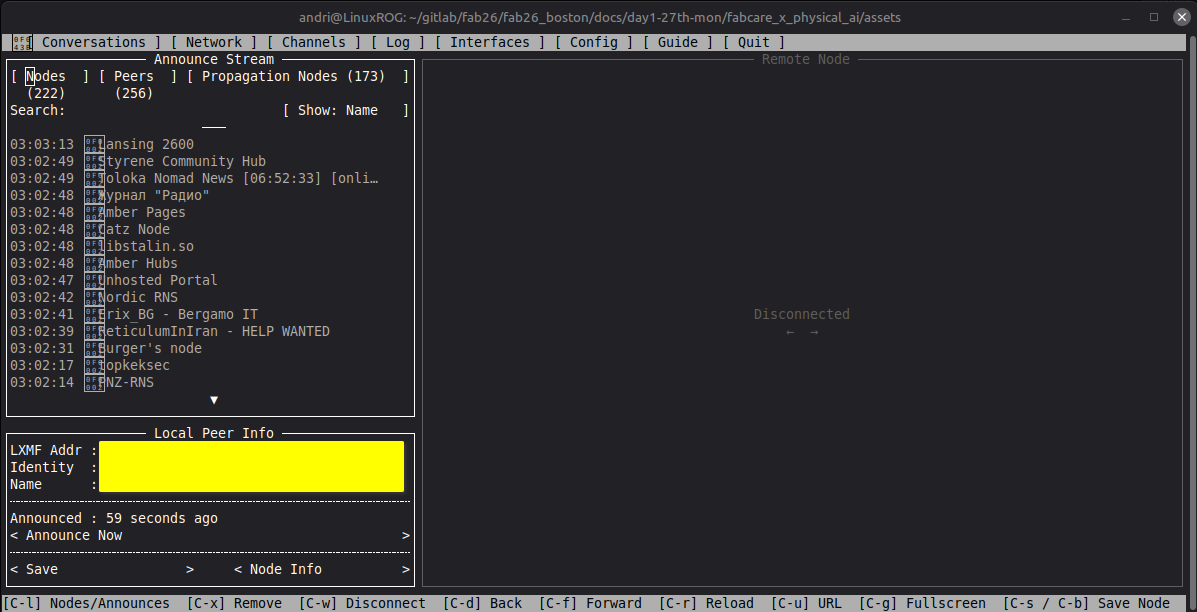
This is the network tab inside Nomad.. im blocking out my LXMF ADDR, Identity, and Name, just in case that stuff is sensitive. ( I actually don't know if this is sensitive information right now, just being safe)
LXMF is basically my personal "ip" address, or "email" people can use to send me messages (my identifier on NomadNet).
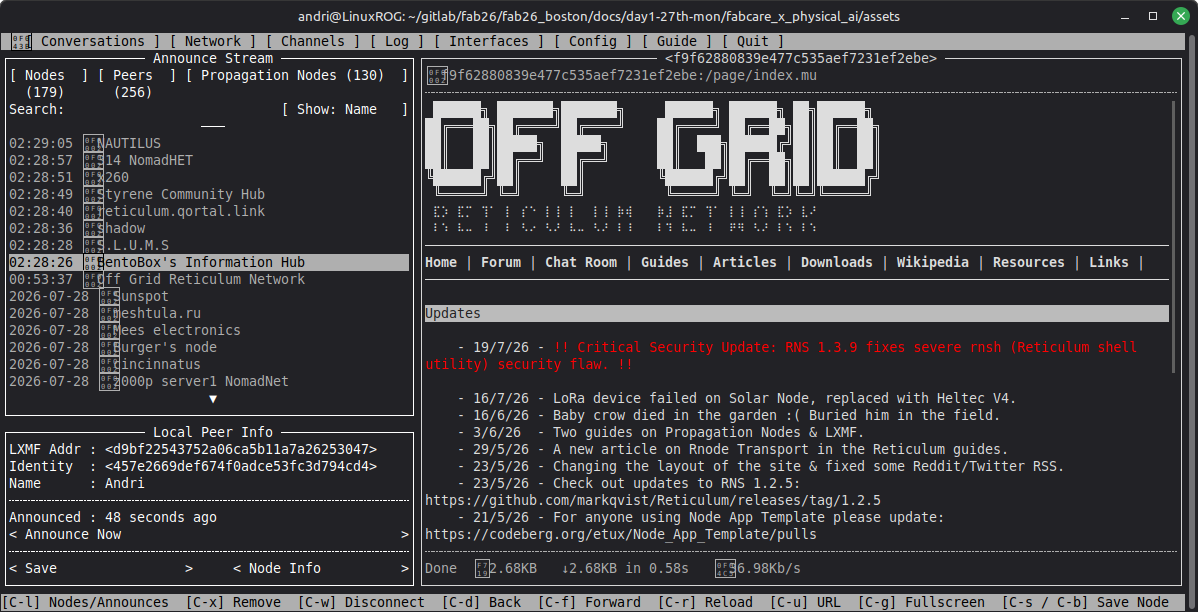
I can click any of the Announced streams, "webpages", and see what people are broadcasting>
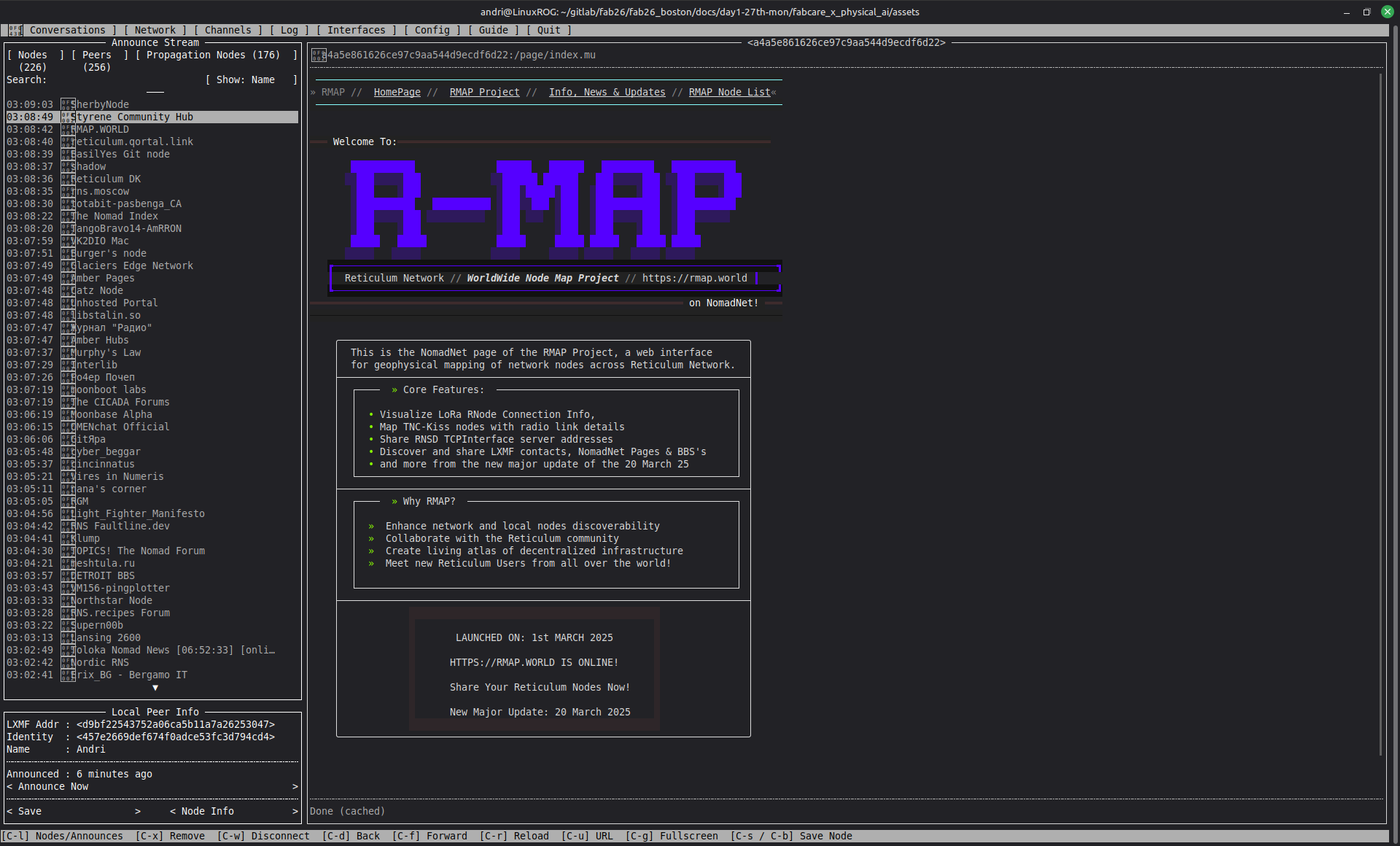
To create your own webpage you create a markdown type page.
I was able to create my own "webpage" using this site, to create a .mu file which I then added to my /home/andri/.nomadnetwork/storage/pages/index.mu

I also had to mess with the configure file which David helped me through and I did not document that properly, but if you need help then I can guide you through it? maybe?
Hands-on Experience
One of the highlights of the workshop was seeing Reticulum route messages over different types of connections. After getting my Heltec V3 configured, I was able to turn off the Wi-Fi on my laptop and still send a message through my USB-connected LoRa radio. The message was transmitted over LoRa to another node, which then forwarded it over Ethernet before finally reaching David through a Wi-Fi connection. Lora transmitter -> Lora receiver -> Ethernet -> Wifi
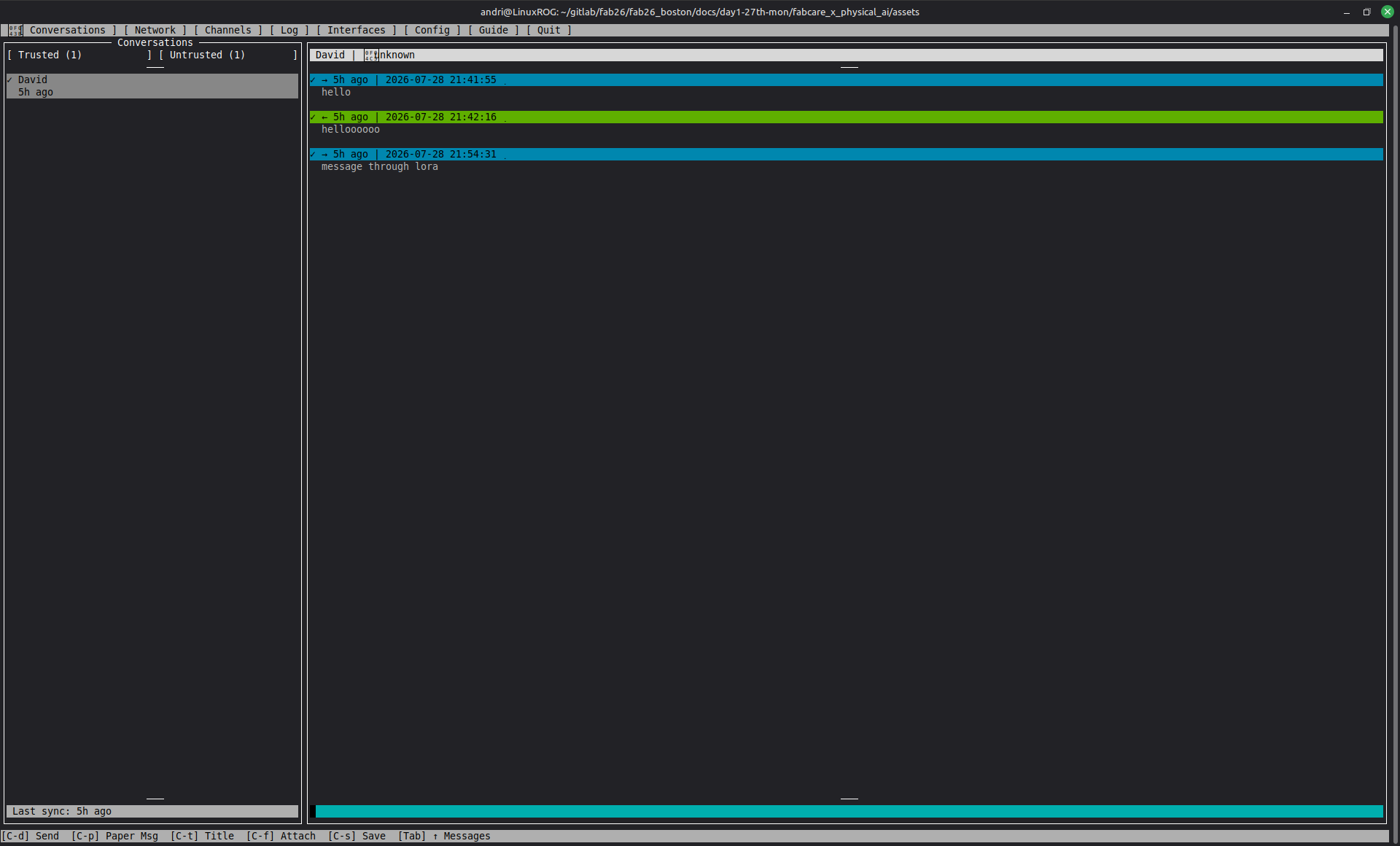
It was my first time seeing a message successfully travel across multiple communication technologies as part of a single network. Instead of thinking about whether something was using Wi-Fi, Ethernet, or LoRa, Reticulum treated them all as parts of the same network and found a path to the destination. Watching that happen in real time was one of those moments where the concepts suddenly clicked.
The workshop was only two hours long, but I honestly think it could have been twice that. Just as everyone was getting their hardware working and beginning to experiment, it was time to pack up. Even so, it was enough to convince me that I want to keep exploring this technology. I plan to continue experimenting with my Heltec V3, learn more about Reticulum and NomadNet, and see what kinds of decentralized applications and projects I can build with them.
Resources
Resources
Official Documentation
Useful Tools
Learning Resources
Extra
I do have the full Google doc provided during the workshop but I am not sure if it should be fully available online, contact me if you want to see more