Brewing Beer and Fablabs
From Wikipedia:
"Beer is an alcoholic drink produced by brewing and fermenting starch from grain — usually malted barley, although wheat, maize, rice, and oats are also used. The grain is mashed to convert the starch in the grain into sugars, which dissolve in water to form wort. The fermentation of the wort by yeast produces ethanol and carbon dioxide in the beer. Beer is one of the oldest and most widely consumed alcoholic drinks in the world, and one of the most popular beverages overall. Most modern beers are brewed with hops, which add bitterness and other flavours and act as a natural preservative and stabiliser. Other flavourings, such as gruit, herbs, or fruit, may be added or used instead of hops."
I made two beers for this event:
- A Duvel Triple Hop-style beer
- A Hazy New England IPA (NEIPA)
For the first one, I concentrated on the entire brewing process (more on this later). For the NEIPA, I focused on a (for me) different way of fermenting. But I promise that for the next batch I'll do the whole thing from grain (more fun, and it saves money 😉).
Brewing Is Making
Why a brew kettle belongs in a fablab
A fablab is a place where people make things instead of buying them. Where you open the black box, look inside, and find out that the mystery was never magic — just process, materials, and someone who bothered to learn. Beer is exactly that kind of black box. It arrives cold and finished, in a bottle with a logo, and it tells you nothing about where it came from. Until you make it yourself.
From scratch means understanding
Brewing from scratch is a crash course in applied everything. You are running a biological reactor: enzymes converting starch to sugar within a few degrees of tolerance, yeast metabolising that sugar into alcohol and CO₂, pH and water chemistry quietly deciding whether your beer tastes bright or muddy. It is chemistry, microbiology, thermodynamics and food safety, all in one afternoon and a bucket.
And like everything else in a fablab, it invites hacking. Build your own temperature controller. Log your fermentation. The recipe is open source by nature — no license, no patent, just a process you can read, copy, fork and improve.
Craft is repetition with attention
Anyone can brew one beer. Craft is brewing the same beer twice, on purpose, and knowing why it came out the way it did. That is the same discipline as dialling in a laser cutter or tuning a printer: the machine does not care about your intentions, only your measurements. You learn the smell of a healthy fermentation the way a woodworker learns the sound of a sharp chisel — with your hands and your senses, not from a manual.
Failure is the curriculum
Some batches will be infected. Some will be flat, or cloying, or taste faintly of band-aids. One will boil over across the whole floor, and you will discover that wort is the stickiest substance known to humanity.
Good. This is the part that matters. A fablab is one of the few places where failing is not embarrassing but productive — where a ruined batch is a data point and a story, and where someone at the next bench has failed the same way and will tell you what went wrong. Documentation, iteration, sharing what did not work: brewing rewards all of it, batch after batch.
And then you drink it
Here is where brewing has an edge over almost anything else you can make. A laser-cut sign gets hung on a wall. A print goes in a drawer. But a beer gets opened, poured and passed around — and it disappears, together, with people.
The reward loop is honest and immediate. You cannot argue with a beer. It is either good or it is not, and everyone at the table is a qualified reviewer. It turns a technical accomplishment into a social one: shared, temporary, and best enjoyed while arguing about what to change next time.
That is the whole fablab idea in a glass. Make it yourself. Understand it. Get it wrong. Write it down. Try again — and share the result.
Cheers. Proost. Next batch is already fermenting.
1st recipe: Duvel style triple Hop clone
To make roughly 20 litres of beer, I used the following recipe.
The Grain
To start with, the grain: 5.42 kg De Swaen Swaen Pilsner malt — barley malt with a clean, well-balanced profile that enhances both flavour development and fermentation performance. To brew beer, the malt kernels need to be crushed, since a malt kernel is quite hard. Breaking the kernel allows the starch inside it to dissolve more easily into the brewing water. The starch can then be broken down into sugars, which the yeast in turn converts into alcohol.
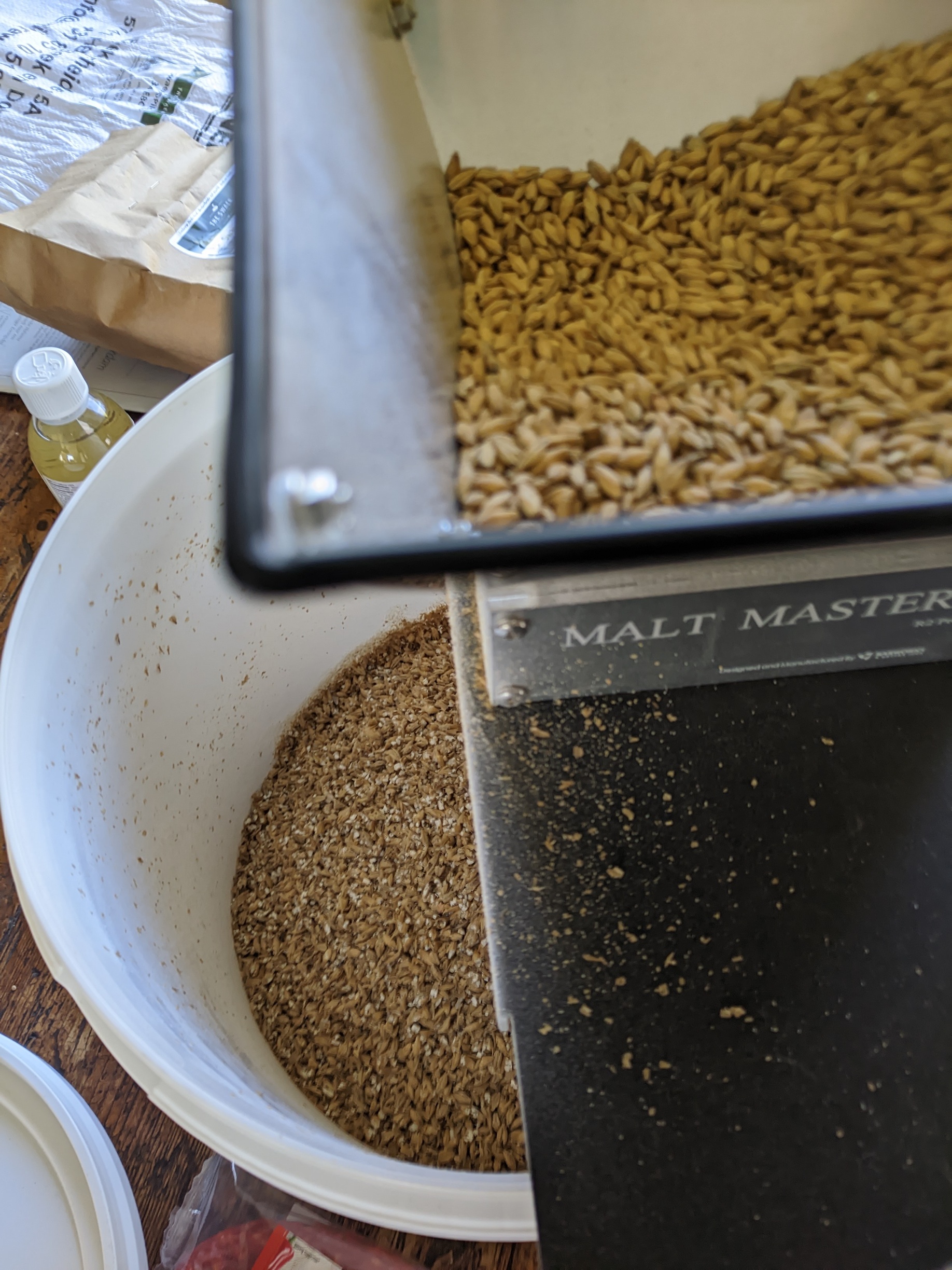
When milling, it's important that the husk stays intact. If it's ground too finely, the husk releases a lot of tannin, which gives the beer a harsh, bitter taste. The husk is also important during the filtering of the wort. The starch, on the other hand, should be distributed as finely as possible, because it then dissolves better. For this reason, malt isn't ground finely but very coarsely.
Mashing
Next, a kind of porridge is made from the crushed malt and water, called the mash. This is heated to specific temperatures to set enzymatic processes in motion, converting the starch from the malt into soluble sugars. The mash is then filtered and afterwards sparged to rinse out truly all of the sugars.
For this recipe I used:
- Mash water: 19.97 L
- Sparge water: 11.81 L
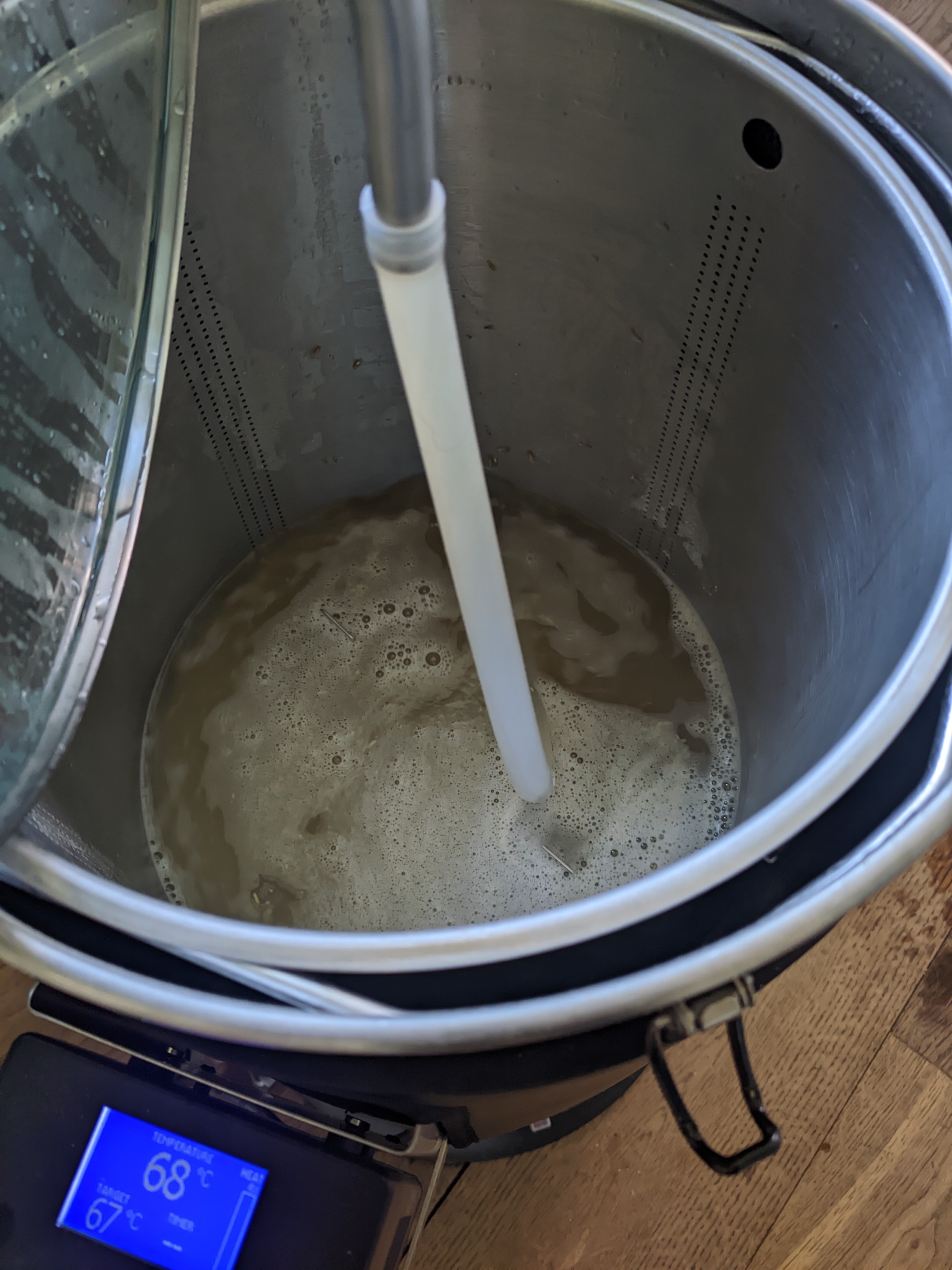
First, I heated 20 litres of water to 72 °C. After adding the milled barley, the temperature was exactly 67 °C. I then held the mash at this temperature for one hour for optimal conversion of starch into soluble sugars. After filtering the mash, 11.8 litres of sparge water at 85 °C was used to rinse the remaining sugars out of the mash and add them to the wort.
The pre-boil gravity was 1.054.
The Boil
Next, the wort was boiled for one hour:
- 58 g Styrian Goldings hops were added right at the start.
- After 45 minutes, the next two hop varieties were added: another 22.5 g Styrian Goldings and 75 g Saaz hops. At that point, 950 g granulated sugar was also added (to ultimately achieve a higher alcohol content).
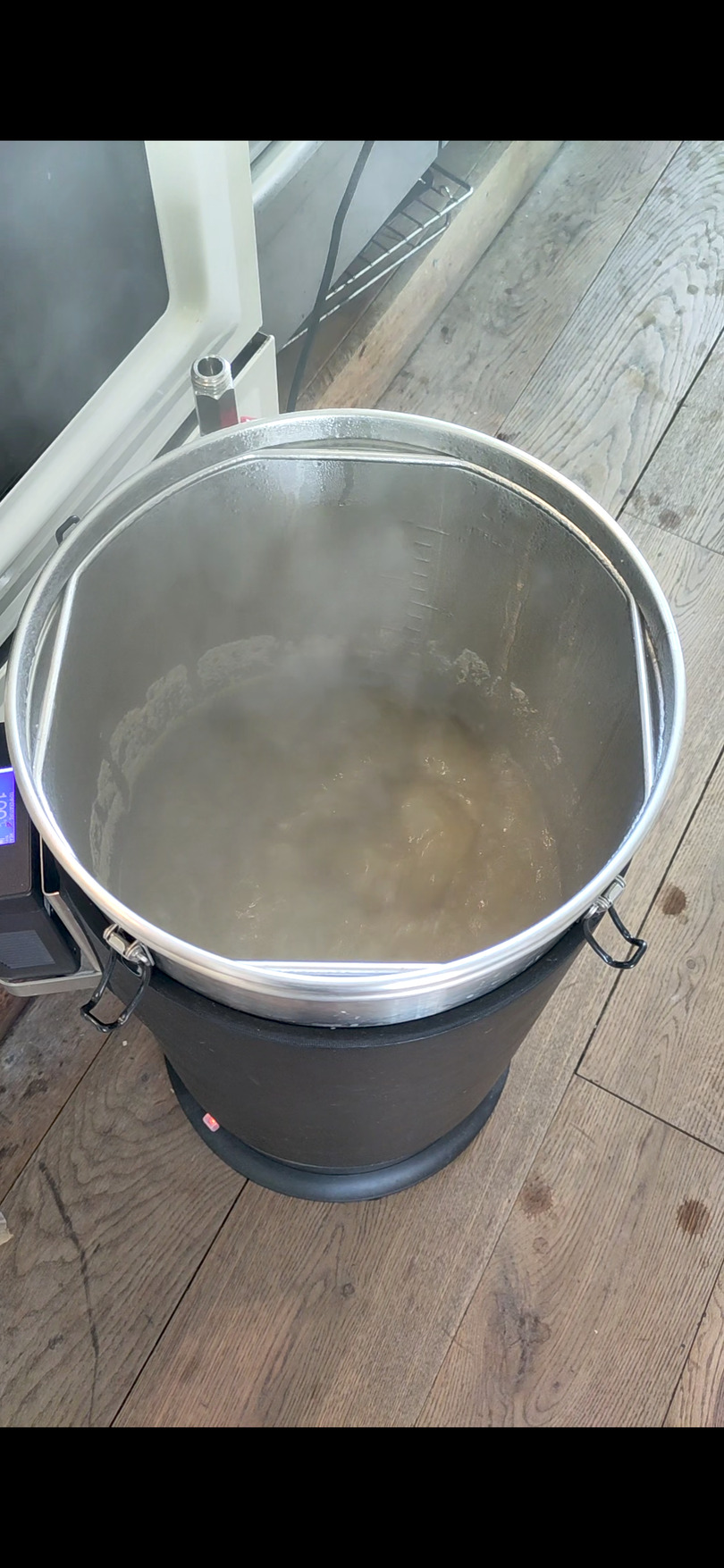
After boiling and adding the sugar, the gravity was 1.073.
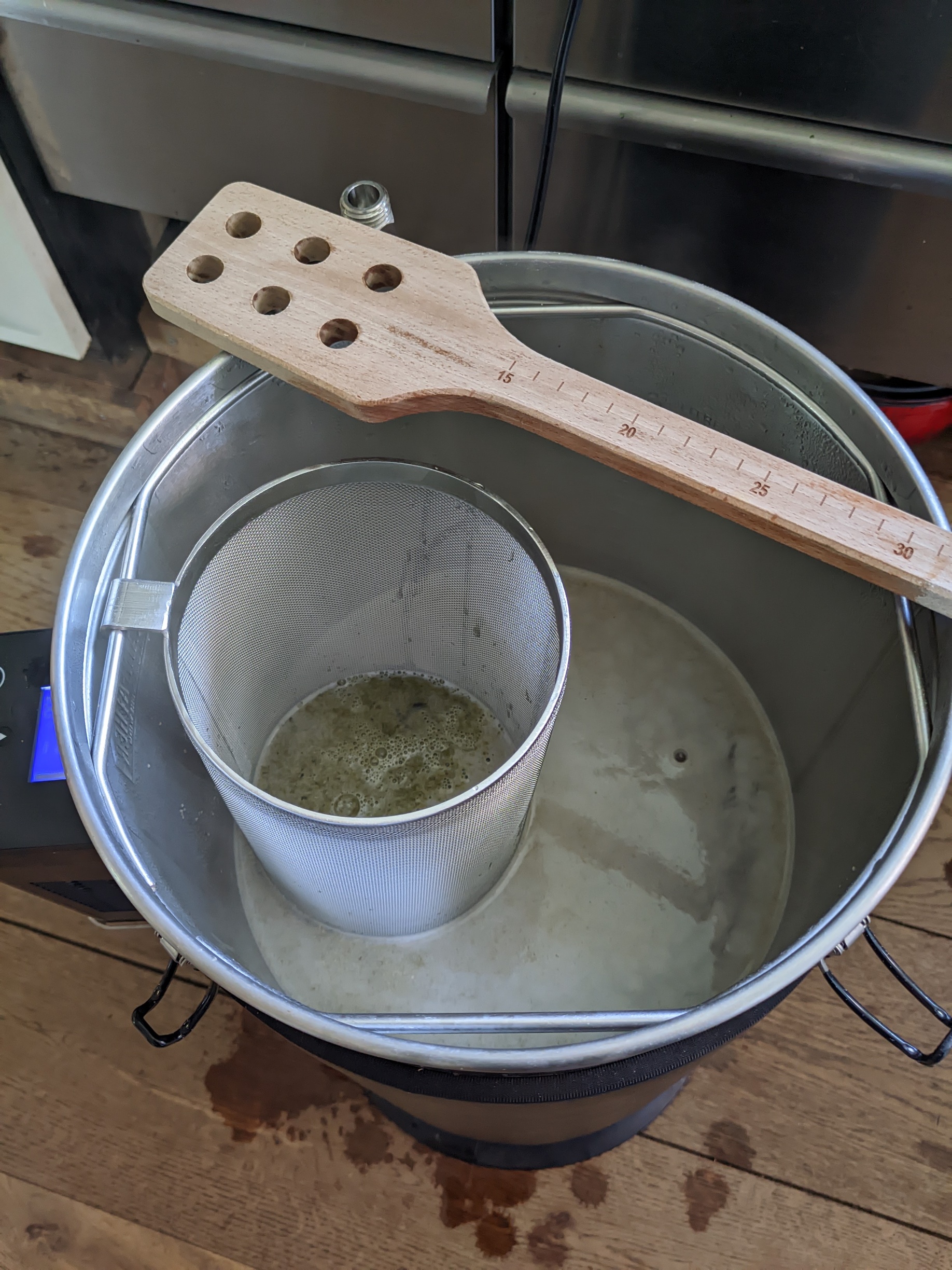
After an hour, the wort was cooled to 75 °C and the third hop variety was added: 17 g Citra. This 75 °C was maintained for half an hour, before cooling the wort down to about 25 °C.
Fermentation
After this, the wort was transferred into a fermentation vessel and Mangrove Jack's M41 Belgian Ale yeast was sprinkled over the wort. The fermentation vessel was placed in a converted refrigerator, where the temperature was kept at 20 °C. After the primary fermentation (3 days), 72 g Citra was added to dry-hop the beer.
After 2 weeks, the beer was ready here, with a final gravity of 1.005. That gives an alcohol content of 8.2%.
Storage & Carbonation
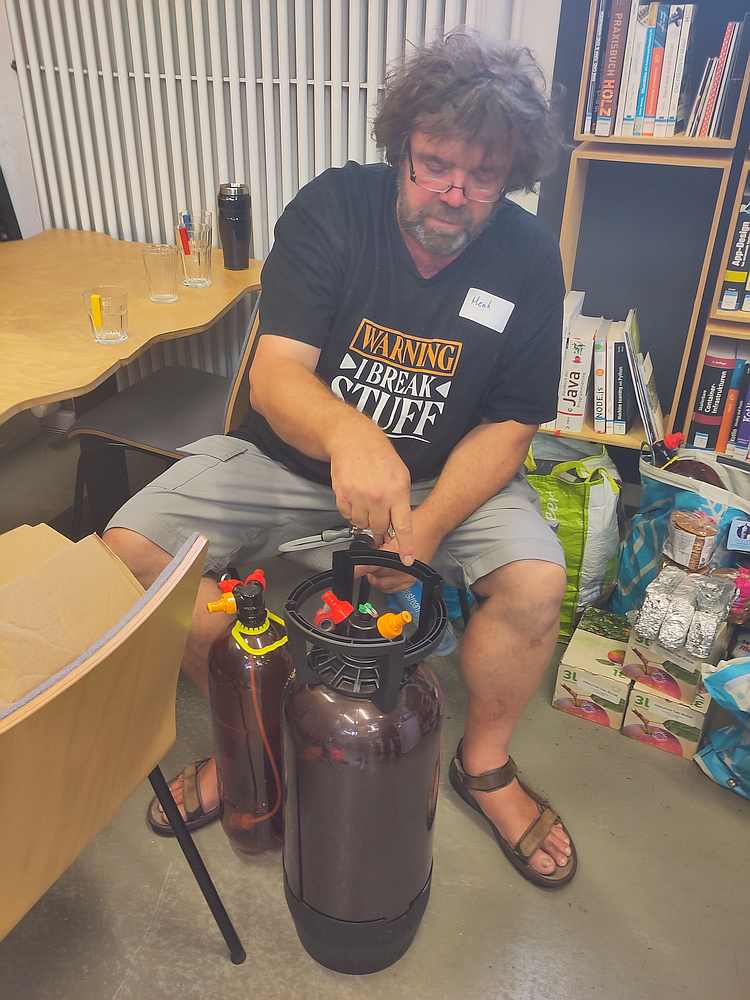
The beer was stored in 20 L Oxebar kegs (kegs made from PETG — Glycol-modified Polyethylene Terephthalate). In this type of keg, the beer can be kept for at least 6 months. 3 volumes of CO₂ were added for carbonation.
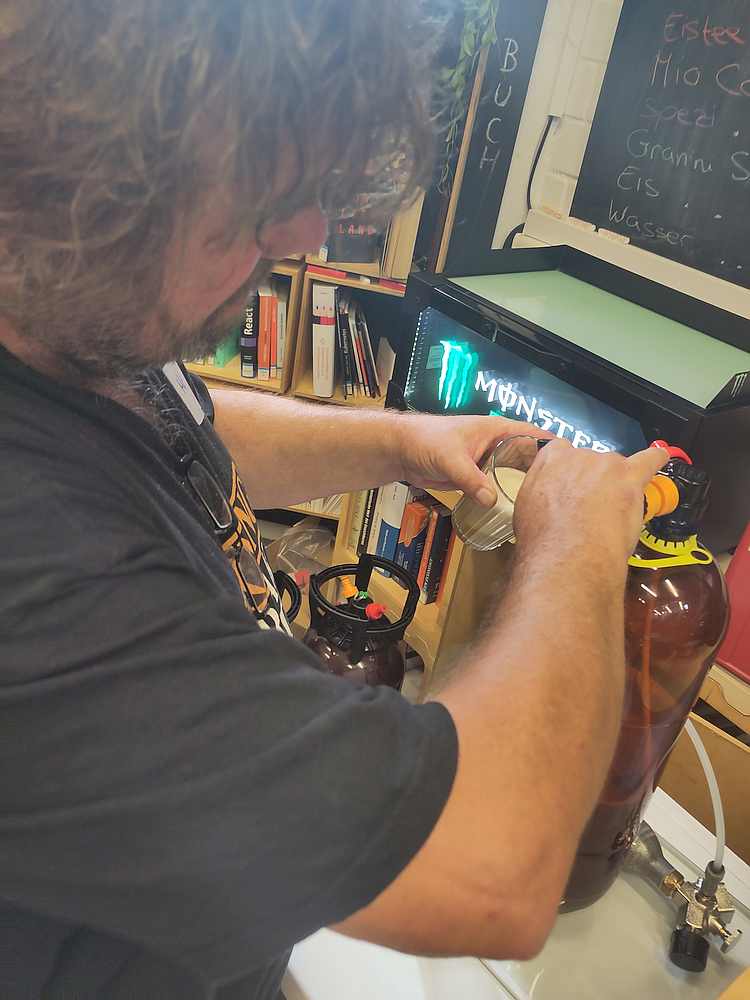
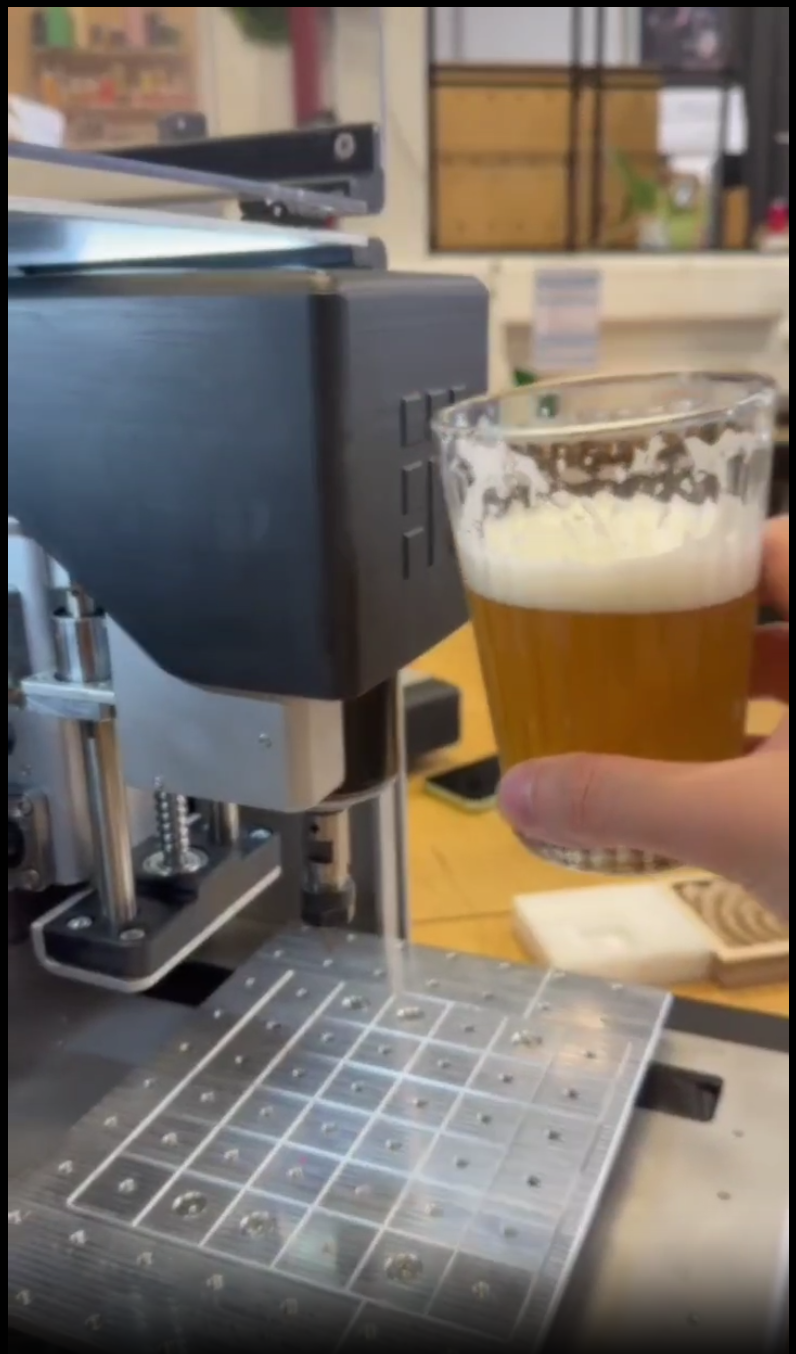
There was a little under 20 L in the keg. It was gone within 4 days.
2. A Beer That Never Meets the Air
20 L New England Hazy IPA — KegLand FreshWort Kit, CellarScience NE Hazy, pressure-fermented at 20 °C / 12 PSI, 200 g cold-side hops in two charges, closed-transferred to Oxebar kegs.
Oh right, laziness is a virtue. But I barely had time for the event, so I opted for this. 20 liters of beer, for which I skipped the entire brewing process (already described above) and threw myself completely into "just in time" delivery and a process new to me, namely fermenting (and storing) under pressure. And a type of beer new to me, namely NEIPA.
It starts with a pouch. No mash tun steaming up the kitchen, no ninety minutes over a boil, no race to chill sixty degrees out of the wort before something wild finds it. The FreshWort Kit arrives already made and already sterile, and the only real ceremony is sanitizing everything it's about to touch — the fermenter, the lid, the pressure relief valve, the posts, the hop dropper, every line you'll need days from now. From here on, the whole story is about what you keep out.
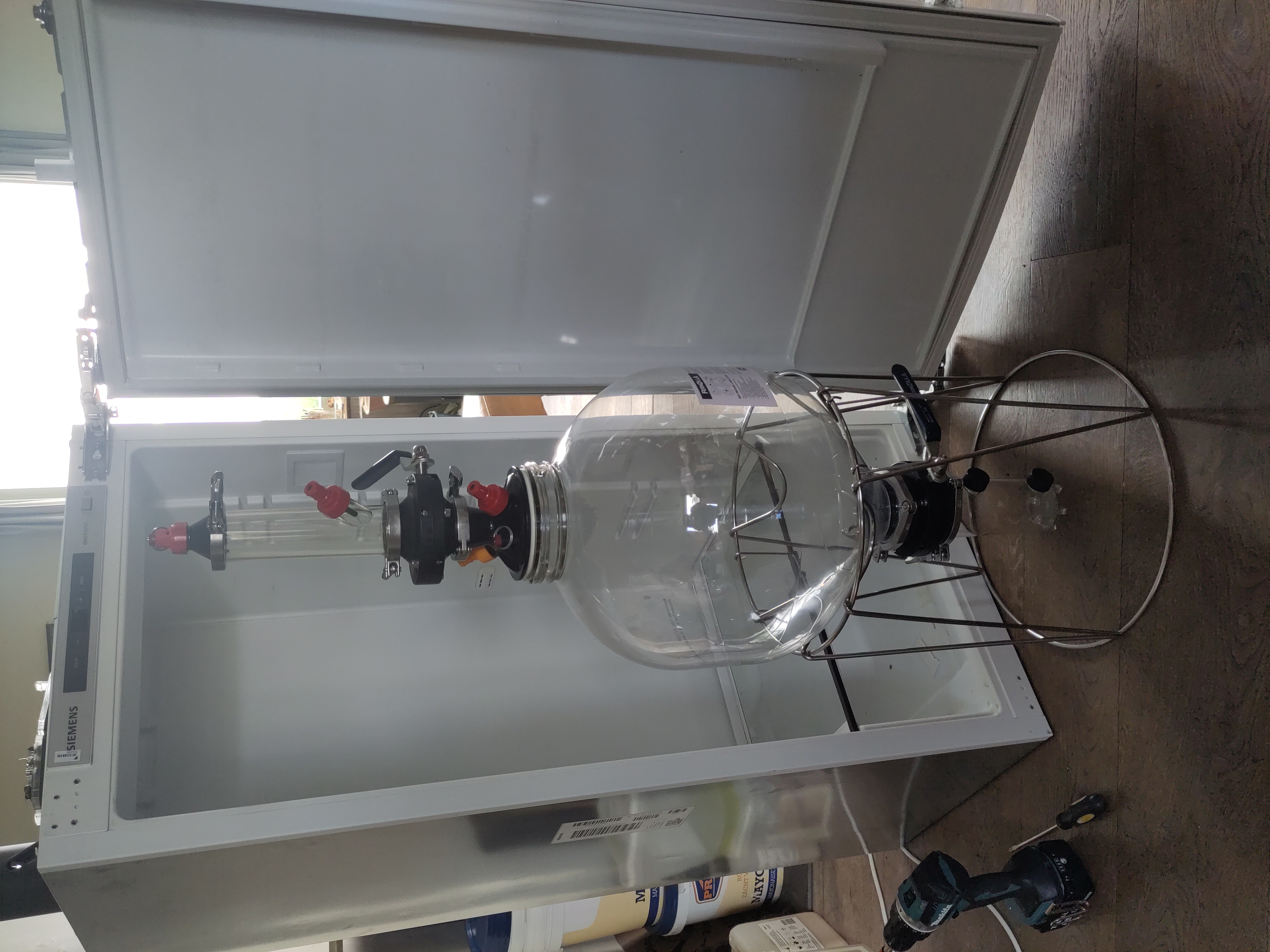
Second hand fridge from the internet: cheap, easy to clean and sanitize. And it this case, almost big enough (not!). Miscalculated the setup: The hop bong (for adding hops under pressure, free from oxygen, and sanitized) didn't fit due to the large number of connectors. I found a workaround. A keg with the yeast collection container at the bottom and all the connections for the hop bong fit perfectly in the fridge. When I use the hop bong, I lift the keg out of the fridge and place it on the wire stand. I add the hops, disconnect the bong, and place everything back in the fridge.
Twenty litres of wort go into the fermenter. You check the gravity, mostly to confirm you landed where you meant to, and bring it down to pitching temperature. Then comes the one moment in this entire process where oxygen is welcome: you shake it, splash it, run an oxygen stone through it — the yeast needs that O₂ to build its cell membranes before it can do anything else.
And then you pitch CellarScience NE Hazy, which is a deliberate choice and not a neutral one. This is a dry strain bred for exactly this style: expressive, ester-forward, and — critically — poorly flocculating. It doesn't want to drop out. Most yeasts you spend the whole process trying to get rid of; this one you're recruiting as a permanent structural ingredient, because yeast staying in suspension is a large part of why the beer will end up soft, pale gold and opaque instead of clear.
You set the fermenter to twenty degrees and close the lid. That's the last breath of air the beer will ever take.
For the first two days you leave the spunding valve wide open and let the yeast be a yeast. This is the growth phase, when it throws the esters that give the beer its fruit, and NE Hazy is a strain you bought for those esters. Clamping down now would flatten the exact character you selected the yeast for. So you let it run free — and while it runs, the krausen pushes a torrent of CO₂ up out of the vessel, scouring every last molecule of air out of the headspace. By the time you're ready to seal it, the fermenter has purged itself.
The first hundred grams
Around day two to three the beer is bruising hard and sitting near 1.020 — past half attenuation, yeast still fully awake. That's the window, and in go Citra, Galaxy and Nectaron: thirty-five, thirty-five, thirty.
This charge isn't really about aroma. It's about chemistry. Live yeast carries β-glucosidase, which cleaves the odourless glycoside-bound precursors in hop matter and liberates the thiols and terpenes locked inside them — isomerising geraniol into citronellol along the way. Galaxy and Nectaron are both loaded with those bound precursors, far more than with free aroma, which makes them close to wasted on a late-only addition and enormous here. Citra brings its own thiol payload and the tangerine backbone. What you get out isn't the smell of the pellets; it's a set of compounds that did not exist in the bag.
You accept, going in, that much of the free aroma from these hundred grams will be scrubbed straight out by the CO₂ still boiling off. That's not a loss — it's the trade. This addition buys transformation, not perfume.
Then the vessel gets sealed and the spunding valve goes to twelve PSI — a little over three quarters of a bar. The fermenter goes quiet and firm, and the physics changes.
Twelve at twenty is a conservative, well-judged setting, and it's worth being clear about what it is and isn't doing. Pressure fermentation is often used to chase speed: crank the temperature to twenty-four or twenty-six and lean on the pressure to suppress the fusels that heat would otherwise produce. You didn't do that. You held a normal, comfortable twenty degrees — right in NE Hazy's happy range — and used the pressure as insurance rather than as a licence. So the yeast expresses close to its natural profile, just with the rougher edges filed off: fewer higher alcohols, a cleaner finish, none of the solvent heat that a big hazy can develop when it runs away from you. The beer you get is the beer the strain wants to make, minus the harshness.
Twelve PSI at twenty degrees also puts roughly 1.7 to 1.8 volumes of CO₂ into solution — most of the way to a finished beer's carbonation, achieved by the fermentation itself while you did nothing. That number climbs further the moment the beer goes cold.
The hops brought a complication in with them, too. Hop matter carries amylase, which chews residual dextrins into fermentable sugar and quietly restarts a fermentation you thought was finished — hop creep. A hundred grams into an actively fermenting beer is a textbook trigger. In an open system that's how you get diacetyl and grenade kegs. Here it's a non-event: the surplus CO₂ bleeds off at twelve PSI, and the roused yeast cleans up its own diacetyl on the way past. The closed system absorbs the problem without you touching it.
The second hundred grams
Fermentation finishes. You bring the temperature down to around eighteen, and the second charge goes in — Mosaic thirty-five, El Dorado thirty-five, Cashmere twenty-five, and five grams of Zappa riding along as an accent.
Everything about this addition is the opposite of the first. There's no active fermentation now, so nothing gets scrubbed away and nothing gets transformed. What goes in is what you smell. Mosaic carries the blueberry-and-mango weight, El Dorado the stone fruit and candied sweetness, Cashmere the soft coconut-and-melon rounding that keeps the whole thing from turning sharp. And then Zappa — a neomexicanus hop, wild in a way the others aren't, with a mint and tropical-funk edge that would bulldoze the beer at thirty grams and does something far more interesting at five. Two and a half percent of the total hop bill, and you'd notice if it weren't there.
Cooler matters, too. Dropping those two degrees slows the extraction of harsh vegetal polyphenols out of the plant matter while the aroma oils keep dissolving perfectly well. Two to three days of contact, then you stop. Longer and you start pulling grassy, tea-like tannin from the same hops that just gave you the fruit — the beer would get more hoppy and worse at the same time.
The whole lot goes in through the hop dropper, both times. Loaded, purged with CO₂, dropped through a chamber that never once opens to the room. Two hundred grams into a sealed, pressurized vessel without ever unsealing it. Ten grams per litre, which is a serious hop bill — and the entire reason every other decision in this process is built the way it is.
Cold, and then across
Then down to cold, and held there. Hop debris drops out, the heaviest protein haze drops out, and the cold sharply raises how much CO₂ the beer will hold — that 1.7-ish volumes at twenty degrees climbs toward serving carbonation on its own, at the same head pressure, simply because cold beer dissolves more gas. NE Hazy being what it is, plenty of yeast simply refuses to leave, which is precisely why you chose it, and why the beer stays opaque rather than falling bright on you.
In any other fermenter this is the most dangerous moment of the brew: cooling gas contracts, the vessel goes negative, and it inhales through the airlock, pulling oxygen straight into finished, heavily dry-hopped beer. Under twelve PSI that cannot happen. There is no negative to inhale into. If you're on a conical, you dump the compacted trub and move on.
The kegs are prepared before the beer ever sees them — filled to the brim with sanitizer, then pushed completely empty with CO₂, so what remains inside is a keg full of pure CO₂ with no trapped pocket of air anywhere in it. A liquid line runs from fermenter post to keg post, the keg's pressure set just below the fermenter's, and the differential does the rest. The beer walks across on its own. It doesn't splash, doesn't foam, doesn't degas, and doesn't meet the atmosphere. What vents out of the keg is the CO₂ that was already living there.
The Oxebar kegs matter here specifically. Plain PET breathes — slowly, invisibly, but it breathes, and ten grams a litre of late hops is the single most oxygen-fragile thing you can put in a keg. The thiols you spent an entire biotransformation charge liberating are among the first compounds to die; the beer goes dull, the pale gold creeps toward orange-brown, the fruit turns to cardboard. The multi-layer barrier is what stops the beer you just protected so carefully from being ruined through the wall of its own container over the following weeks.
There's barely an ending, which is the point. The beer arrived at the keg already carbonated, so there's no forced-carb wait, no shaking, no guessing. Set serving pressure, give it a few days cold to let the two hop charges knit together, and pour.
What you actually built is a beer that met oxygen exactly once — deliberately, at pitching, when the yeast was hungry for it — and never again. Every choice after that compounds: the self-purging first two days, twelve PSI holding the line from day two onward, the sealed hop drops, the pressure that made cold crashing safe, the closed transfer, the barrier kegs.
And with this one the clock is real, no matter how well you protected it. Drink it young.
The build, in short
Batch: 20 L · Wort: KegLand FreshWort Kit · Yeast: CellarScience NE Hazy Fermentation: 20 °C, open for 2 days, then sealed at 12 PSI on a spunding valve Dry hop total: 200 g = 10 g/L, all cold-side, all via sealed hop dropper
Charge 1 — day 2–3, active fermentation, ~1.020 (biotransformation):
| Hop | Amount |
|---|---|
| Citra | 35 g |
| Galaxy | 35 g |
| Nectaron | 30 g |
| 100 g |
Charge 2 — post-fermentation, ~18 °C, 2–3 days (aroma):
| Hop | Amount |
|---|---|
| Mosaic | 35 g |
| El Dorado | 35 g |
| Cashmere | 25 g |
| Zappa | 5 g |
| 100 g |
Packaging: cold crash under pressure → closed pressure transfer → CO₂-purged KegLand Oxebar barrier kegs
Photo from the audience